rom Statistics to Street Theater: How UMD Researchers are Merging Data and the Arts on the Streets of Nairobi
Academic research too often remains locked within scholarly journals, failing to reach the very communities that provided the data.
To disrupt this traditional dynamic, Professor Sangeetha Madhavan (Sociology and Africana and African American Studies) launched an initiative to translate findings from the JAMO project—an NIH-funded longitudinal study on marriage, kinship, and child well-being in Nairobi, Kenya—into accessible, community-driven artwork. Her project was funded through a fellowship from Arts for All, an initiative committed to launching cross-disciplinary projects and creating transformative experiences on campus and beyond.
Rather than treating the Global South as a passive source for data extraction, Madhavan’s framework centers on co-creating artistic manifestations of research findings with community-based arts organizations; her goal is to establish a dialogue between academic findings and community lived experiences in order to democratize sociological knowledge.
Building directly upon this vision, UMD Sociology doctoral student Katia Destine recently returned from a five-week research trip to Nairobi where she conducted an ethnography of the research translation process itself. Destine, who brings a background in visual arts and is also supported by an Arts for All fellowship, operated with a foot in both academia and creative practice.
Working alongside local field researchers, she connected with two key community organizations: Beyond Initiative for Social Concern (BISC) and the Ubunifu Arts Center. Before embarking on any creative work, the research team engaged in extensive inception meetings, seeking approval from village elders and local governing bodies as it navigated complex administrative bureaucracies and worked to safeguard vulnerable populations.

Professor Sangeetha Madhavan and field interviewer Raphael Musyoki from the African Population and Health Research Center present JAMO research findings in English and Swahili to village elders in the Viwandani settlement of Nairobi, Kenya. PC: Katia Destine
Throughout her fieldwork, Destine served as an ethnographic observer, documenting how local youth artists understood and reinterpreted complex demographic data. Rather than dictating the final artistic products, she walked participants through JAMO findings on "union formation"—the prolonged, economically complex marriage process in informal settlements—and its ripple effects on kinship and child support. The artist groups then pitched and executed their own creative translations.
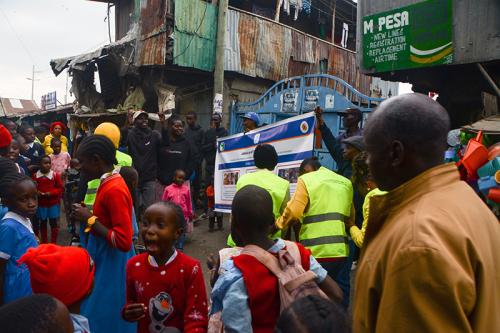
BISC, a majority Gen Z theater troupe, performed Swahili "invisible theater," creating spontaneous street spectacles and comedy skits with embedded audience facilitators during peak hours, such as when school let out or when workers were returning home. Meanwhile, Ubunifu Arts Center produced vibrant musical performances with drums and painted three community murals centering on generational family relationships among grandmothers, mothers, and children, emphasizing the importance of kin.
In the Viwandani informal settlement of Nairobi, Kenya, the local youth-based organization Beyond Initiative for Social Concern (BISC), in joint collaboration with the African Population and Health Research Center (APHRC) and the University of Maryland, presents a series of invisible theatre performances. PC: John Kung'u
Now back at UMD, Destine is advancing into the analytical phase of her project. She is currently transcribing audio recordings, coding field notes, and using mixed-method triangulation to compare the artists' creative outputs directly against JAMO’s longitudinal dataset. Her findings will form the basis of a paper analyzing how scientific knowledge is contested and refashioned at the grassroots level, highlighting how African youth use art to dismantle stock academic narratives. She and Madhavan are also hoping to present their work in an exhibition that includes a Q&A with the artists themselves.
These insights directly inform the next steps envisioned in Madhavan’s broader translational agenda. Moving forward, Madhavan and Destine would like to expand these arts-based dissemination models by bringing together Black men in Nairobi and the DMV to co-create "male provider maps" to highlight their roles as fathers, partners, and caregivers amidst shared economic challenges. This would be done in collaboration with UMD's Center for Community Engagement, and funding will be sought from foundations such as Mellon and Ford.
Ultimately, they plan to formally evaluate how creative translation impacts knowledge acquisition and community empowerment. Together, Madhavan and Destine are working to expand public sociology and dismantle Global North/Global South distinctions, all the while demonstrating that research can serve as a tool for collective empowerment the world over.
Through musical performances featuring drum beats, singing, and dancing, the Ubunifu Arts Center, alongside field researchers Ann Muthoni and Clement Ambuka from the African Population and Health Research Center, connects with the local community in Korogocho, Nairobi, Kenya, to share findings from the JAMO project. PC: Micko Migra
This article was orginally posted on the Department of Sociology Website.